November 2026 · Capital
The buyer mix moved. The IG supply didn’t.
Single-tenant net lease traded $51 billion across industrial, office and retail in 2025, up 16%, per CBRE.
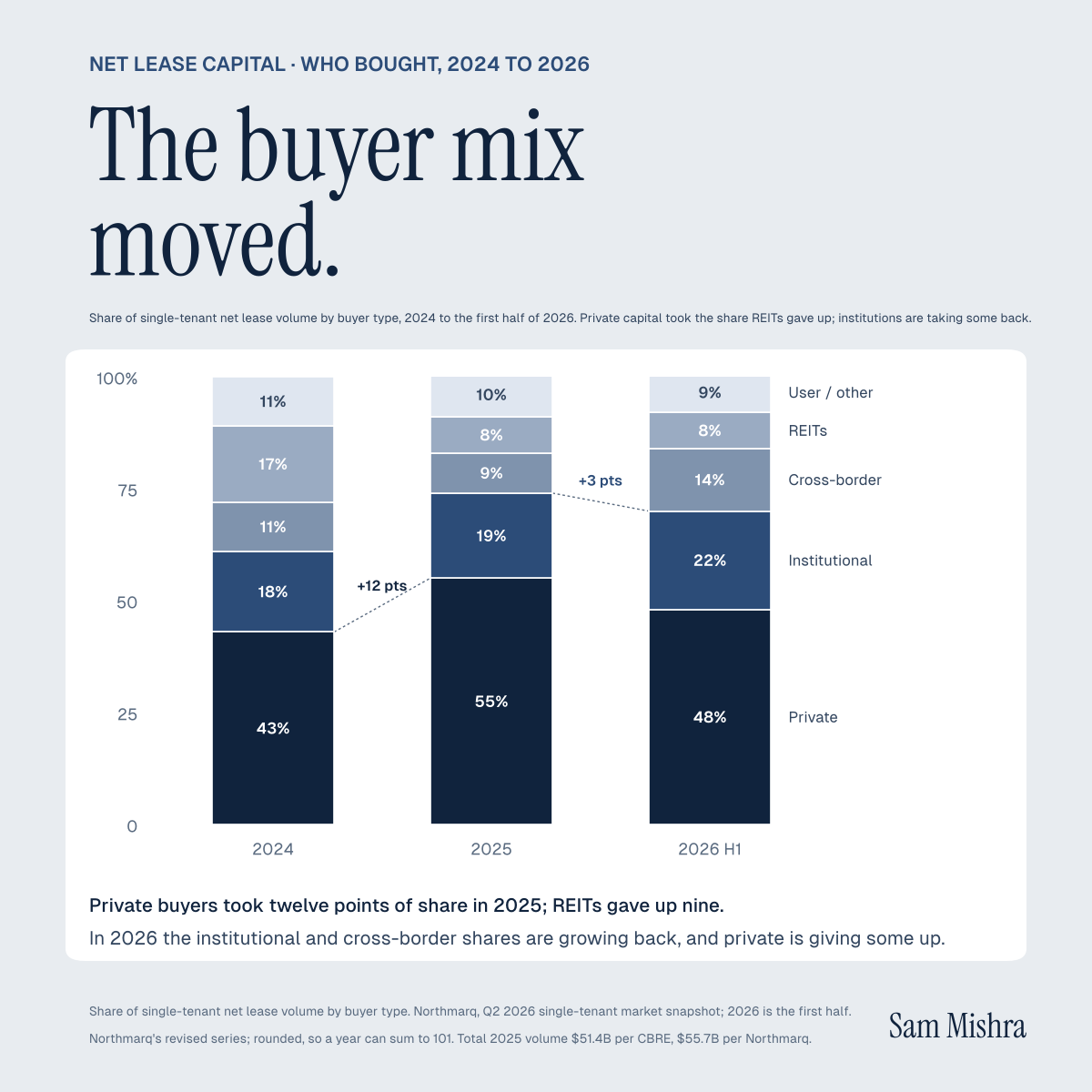
→ Private buyers went from 43% of volume to 55% in a year, per Northmarq. REITs fell to 8% from 17%; institutions held a fifth. In 2026 H1 institutions rose to 22% and cross-border to 14%; industrial was 31% through September.
→ More private money arrives on a 1031 clock. DST equity, which I charted in October, rose 49% in 2025 to $8.4 billion per Mountain Dell Consulting, heading for a record $10 billion; it wants IG credit on a long lease.
→ The dedicated IG money had a record year; Blue Owl raised $6.5 billion for net lease in 2025. In 2026 TPG Angelo Gordon passed $1 billion on its fifth net lease fund and CBRE Investment Management bought a $1.6 billion portfolio to seed one.
→ The IG product is thin: The Boulder Group puts IG tenants with long-term leases at under 10% of retail deals on the market.
So one thin slice, IG credit on a long lease, is pulled two ways: tax-motivated capital that now prefers it to multifamily (industrial 39% of DST equity through September, multifamily 22%, per Mountain Dell), and institutional and core funds that require it. Neither can buy what isn’t for sale. The other nine-tenths, below IG or short on term, is where most of the market trades and neither pool goes.
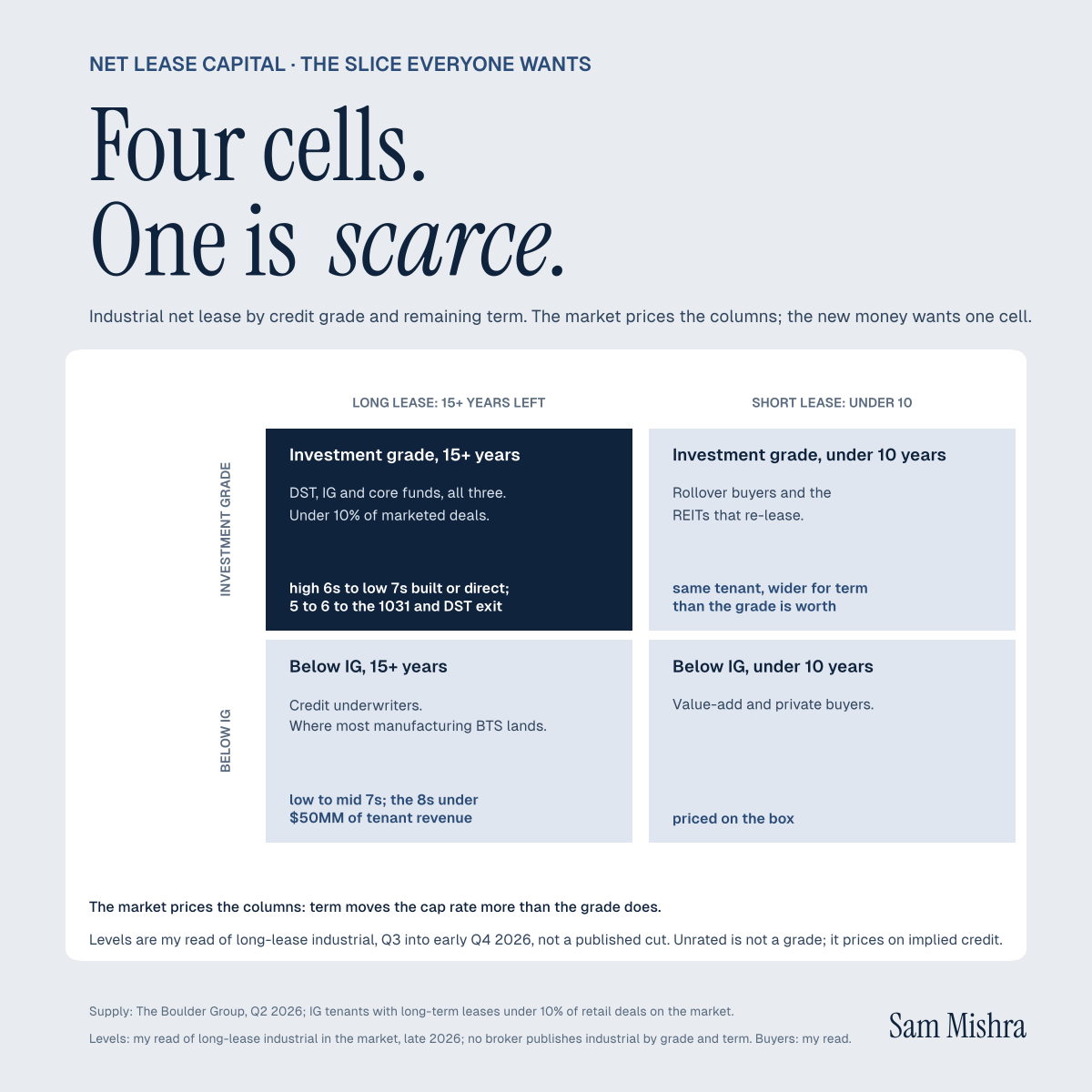
Surveys split by sector and term, not grade. Boulder’s tenant profiles do both, for retail, restaurant and bank tenants; term matters more: the median IG tenant asks 5.50% at fifteen years and 6.75% at five; below IG asks 5.85% at fifteen. Term is worth 125 basis points, the grade about 35.
Nobody publishes this cut for industrial. On long leases I see high 6s to low 7s for IG, low to mid 7s below IG, and the 8s under $50 million of revenue. Boulder’s retail book is tighter: 1031 and DST pools buy it, and its asks lag the higher-rate market.
Those pools still take stabilized long-lease IG industrial at 5 to 6 caps, Q3 into early Q4; that spread is the exit. The market already prices the term. What it can’t find enough of is the IG credit.
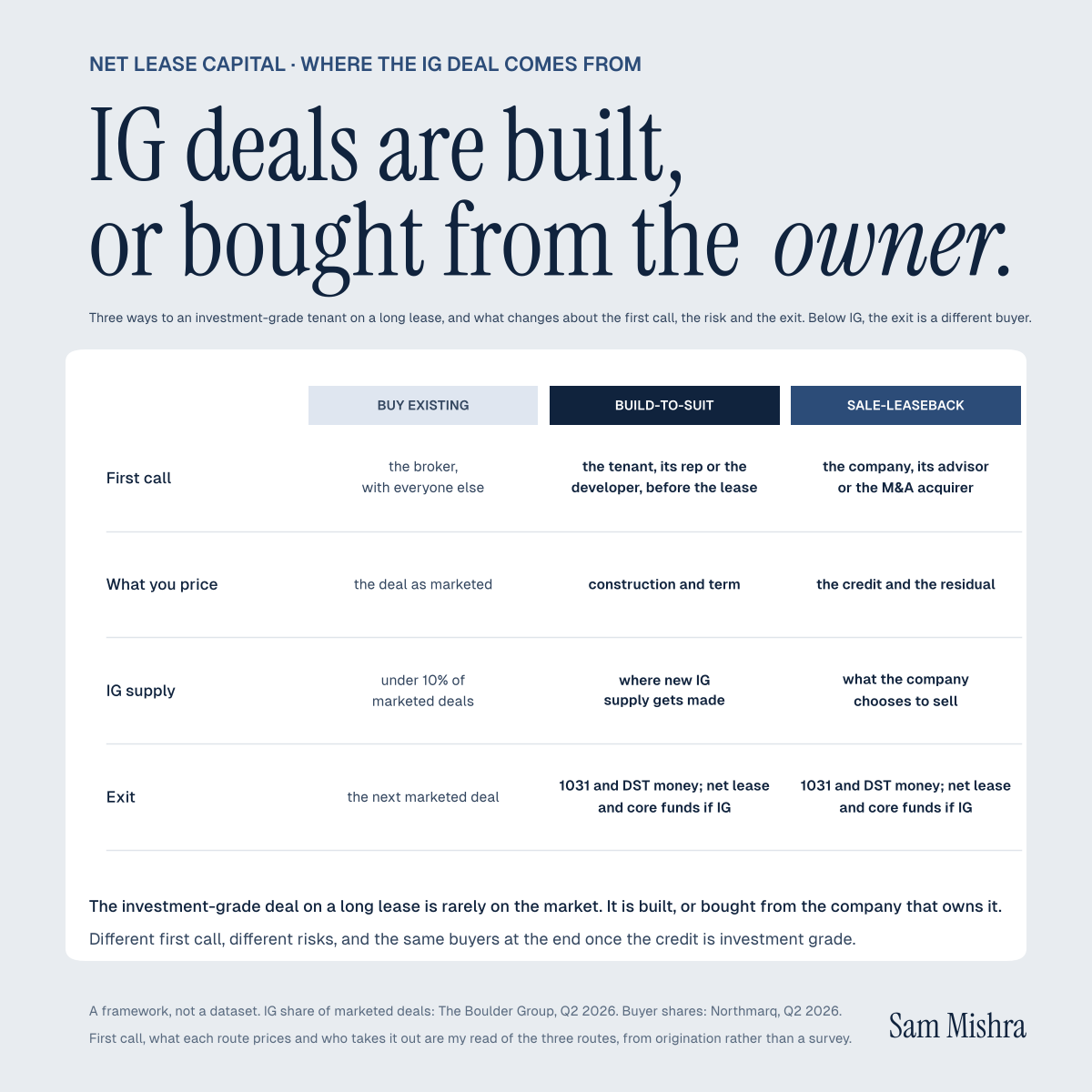
If it isn’t on the market, where does the next IG deal come from?
Mostly from a build-to-suit, or from the company that owns it in a sale-leaseback.
Both differ from buying existing net lease: the first call goes to whoever is at the table before the lease is signed, the tenant, its rep, the developer or the acquirer, not the broker.
The risks are construction and term, not price. Construction risk is real; so are the guardrails, which cover most of it. The exit is the buyer who wanted IG credit all along: build it, season it, and 1031, DST and core money takes it out.
Lease restructures, CTL sponsors, developers who can’t extend and take-privates like Blue Owl and Sila Realty Trust are the other doors; a note of their own.