October 2026 · Capital stack
Where the stack breaks, capital enters
The cracks forming in commercial real estate aren’t in the buildings. They’re in the capital stacks — and if the 10-year holds at 5% or climbs, they widen into chasms.
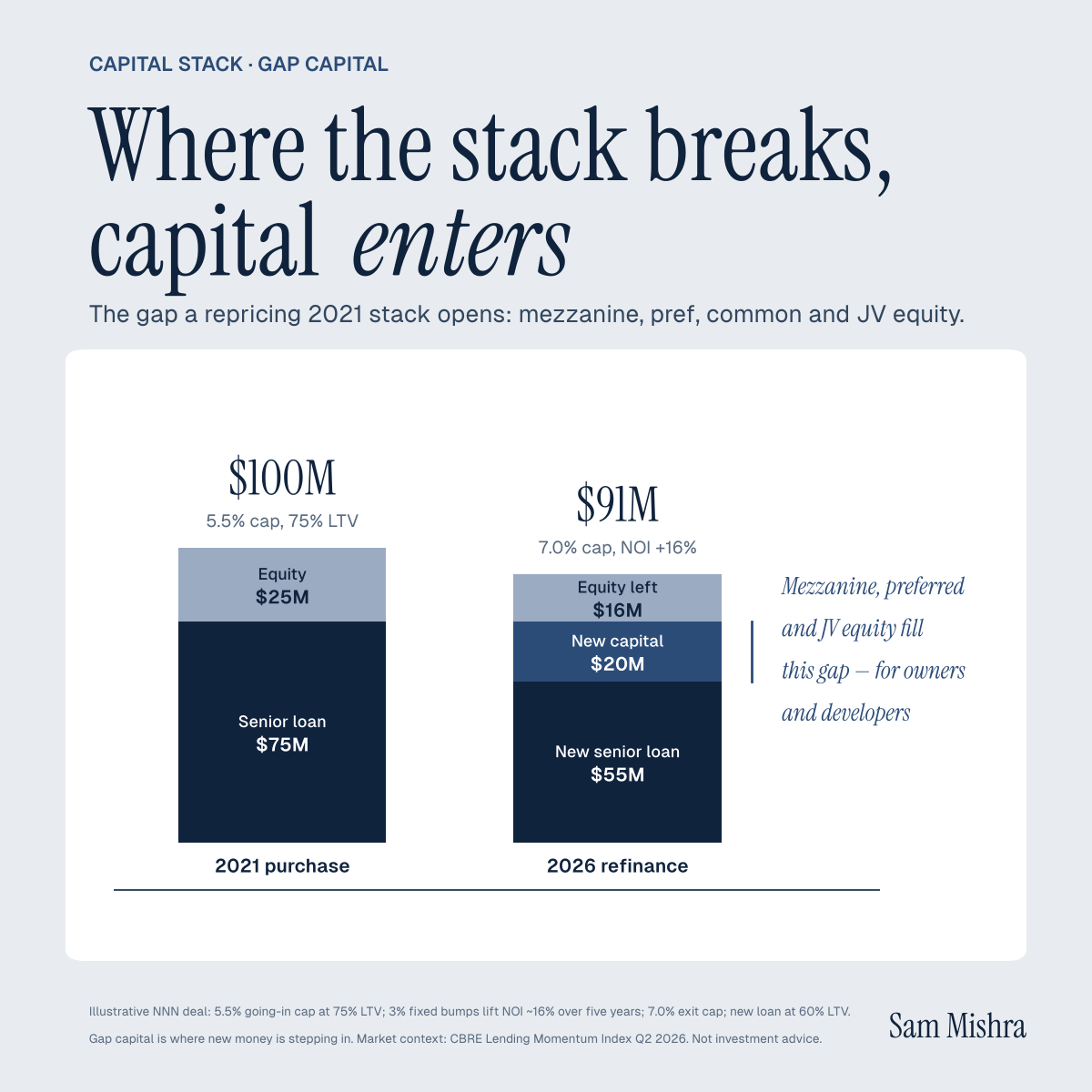
Take a simple, illustrative NNN industrial deal bought in 2021:
- $100M at a 5.5% cap, with a $75M loan (75% LTV)
- 3% annual bumps lift NOI ~16% over five years. The lease did its job.
- But at a 7.0% cap, the asset is worth ~$91M
- A new loan at 60% LTV is ~$55M
Value fell only 9%, and NOI grew 16%. Retiring the old $75M loan still takes the new $55M loan plus ~$20M of fresh capital, and the original $25M of equity is worth ~$16M. The lease performed — most of the gap is simply that 75% leverage does not come back.
Multiply that across everyone who bought or built from 2020 to 2023, refinancing into 2026 and 2027, and a lot of equity is stuck. Owners can’t sell without crystallizing a loss or refinance without writing a new check. Developers can’t recycle equity into the next project. If rates stay here, that’s the chasm: stalled pipelines and recaps that won’t pencil at the old basis.
But where the stack breaks, capital enters. That ~$20M gap isn’t just a loss — it’s the entry point for new money: mezzanine, pref, common and JV equity, recapitalizing owners and funding developers who’ve run out of recycled equity.
The scale is real: $875B of commercial and multifamily mortgages are scheduled to mature in 2026 alone (MBA), and alternative lenders already made 38% of CBRE’s non-agency closings in Q2, ahead of banks at 30%. Capital is already rotating toward the gap.

The telling move is underneath the headline. Alternative lenders lead, but banks gained more ground — six points against four. Between them they took ten, and conduit gave up eight of it. Debt funds get the attention; the banks came back quietly.
That trapped equity opens two books, and they price differently. One is repair: mezzanine and preferred behind a 2021 basis, where you are underwriting someone else’s entry price and the question is whether the asset covers the stack. The other is origination — new construction for a creditworthy tenant at today’s costs and basis, with no legacy stack to inherit. Longer to fund, but you set the terms and you know what the dirt cost.
Where the tenant credit carries it, the debt prices off the tenant’s credit and the lease rather than the building’s value — long-duration, fixed-rate, amortizing against the payment stream, often funding the construction and the takeout as one loan. That is credit tenant lease financing: a different lender and a different exit from the repair book.
Capital alone isn’t the edge, though. The deals that pencil are the ones you source before they’re broadly shopped — and structure so the construction, timing and re-letting risk is priced and allocated, not assumed.
A repricing stack is a loss on paper.
Where it breaks is also where the next capital — and the next opportunity — enters.