October 2026 · Mission-critical
Measuring mission-critical
Almost every net lease memo calls the building mission-critical. Very few say how they know.
Mission-critical isn’t a property of the building. It’s a switching cost — what it costs the tenant to leave — and it can be estimated.
Start with what the market shows, and where it stops. STAG Industrial renewed 90.3% of the 2.9 million square feet rolling in Q3, with cash rents on those renewals up 21.4%. That is a pure-play industrial book on roughly four-year average terms — the liquid end of the asset class, where a tenant who wants to move has the easiest time of it. Even there, rent went up a fifth and nine-tenths of the space stayed.
That’s a floor, not a ceiling — and it’s where the public data stops. Specialized facilities don’t roll often enough, or publicly enough, to produce a dataset. On the asset you’re actually underwriting, the switching cost is one you build yourself.
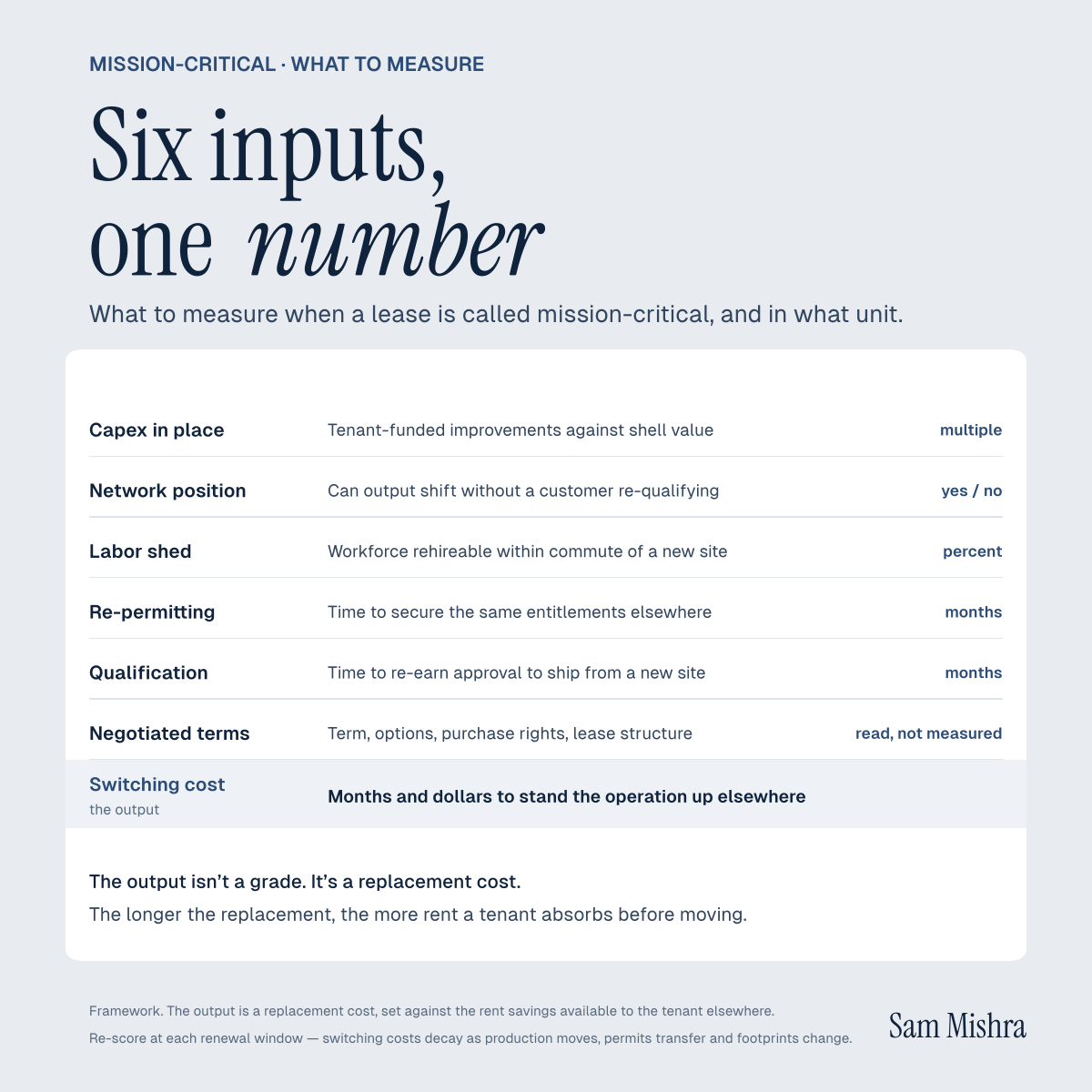
Six components — five you measure, one you read:
- Capex in place that doesn’t travel. Reinforced slabs, heavy power service, process piping, cranes, specialized drainage. Both sides fund it: the landlord takes the building-integrated work, the tenant everything above it. Measure what the tenant put in against shell value — that’s the part they can’t carry out.
- Position in the production network. Single source for a product line, or one of six interchangeable distribution points. The question is whether output can shift to another site without a customer re-qualifying it.
- The labor shed. How much of the workforce could be rehired within commuting distance of a replacement site. Specialized trades in a thin local market are a relocation cost that never appears in the rent.
- Re-permitting difficulty. Air permits, wastewater discharge, hazmat storage, heavy truck access, manufacturing-permitted zoning. Denominated in months, not dollars.
- Time to qualify, not time to build. Design, permit, construct, commission — then qualify. For regulated or customer-audited output, a finished building is not a plant cleared to ship.
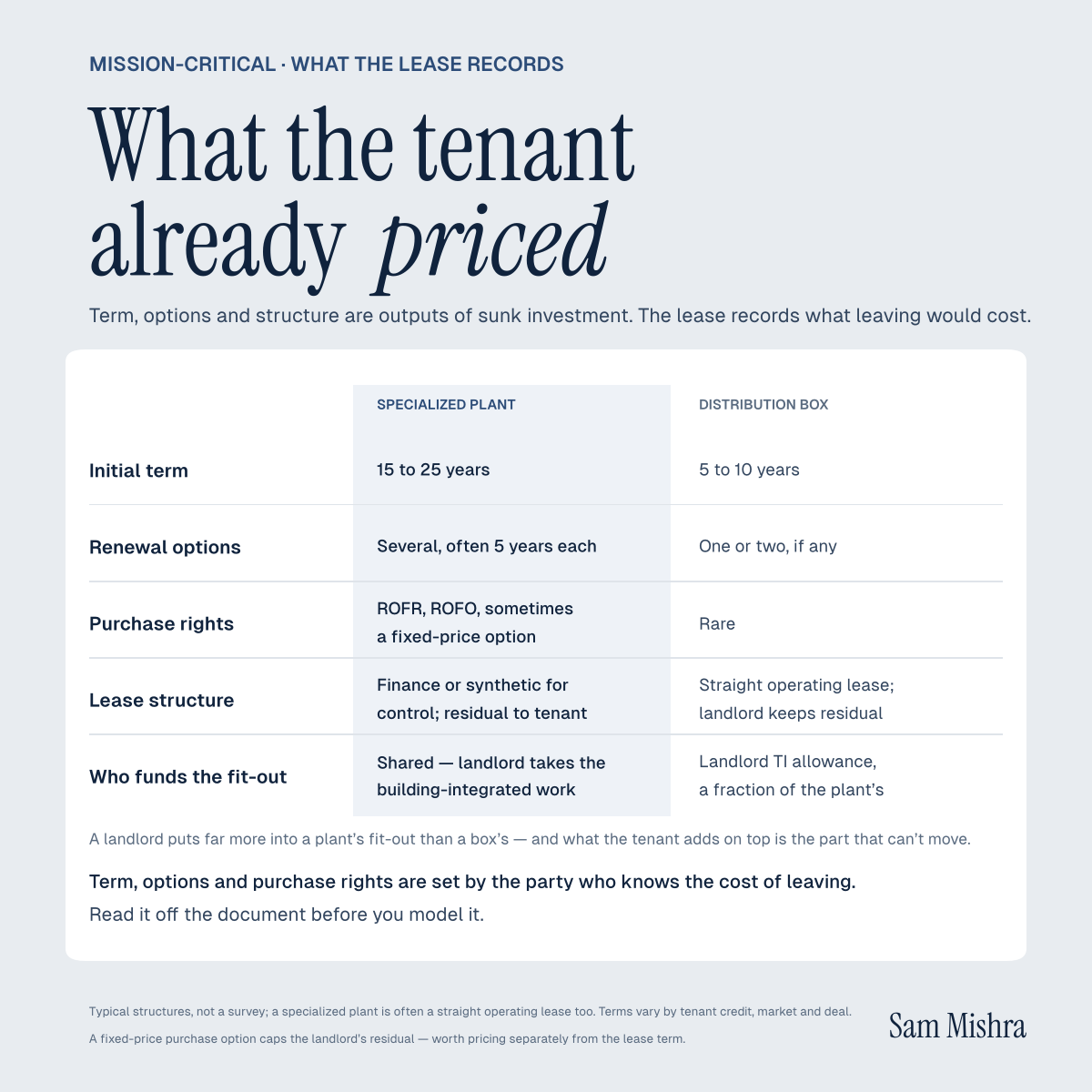
- What the tenant negotiated. Term is a byproduct of sunk investment — long dates, renewal and purchase rights, finance or synthetic lease structures. Each of those moves residual upside from landlord to tenant, which is why they are worth asking for.
That last one is the shortcut. The tenant scored the first five during negotiation, and the result is sitting in the document you already hold.
The output isn’t a grade. It’s a number: months and dollars to stand the same operation up somewhere else. Set it against the rent savings actually available in that market and you have the renewal decision the tenant is going to make — the longer the replacement, the more rent a tenant will absorb before moving.
It isn’t a one-time output either. Re-score it at each renewal window and it drives the ownership decisions too: whether to spend on retention or let space roll, whether to sell ahead of expiry or hold through it. Scores decay. A line relocated, a permit transferred, a second facility opened, and a lease underwritten as critical quietly stops being one.
Scores aggregate, too. Tenants in one industry share switching-cost drivers, so rollover concentrates — and it lands against whatever financing sits over the book.
None of this is free to the owner. The same specificity that keeps a tenant in place concentrates your basis in a building with one plausible user: switching cost lifts renewal probability and loss given default at the same time. That is the trade, and it is worth naming rather than assuming away.
For a credit investor it prices like a spread. Specialized assets clear wider for the same credit and term — and the question worth answering is whether that is paying you for the residual, or overpaying you for a tenant who was never leaving. For a lender it is duration: not whether the tenant is sound today, but whether they are still in the building when the loan matures.
Mission-critical should be a number you produced.
Not an adjective you inherited.