November 2026 · Underwriting
The comp sheet can’t see the fit-out.
In one quarter of 2026, manufacturers’ deal activity narrowly topped 3PLs’ for the first time in recent history, per Cushman & Wakefield. Then, in the body of the same report: “Most of the industrial leasing activity by manufacturers in the U.S. has not been for production facilities.”
Which sounds like it settles whether manufacturers are taking production space. It does not, because a production facility is a building type, not an activity.
Pull up NAIOP’s definitions, the ones the industry wrote for itself. A building sorts into manufacturing, warehouse, distribution or flex on three things: percentage of office finish, clear height, and dock doors per square foot.
Power is not in the matrix. Floor load is not in it. Slab is not in it.
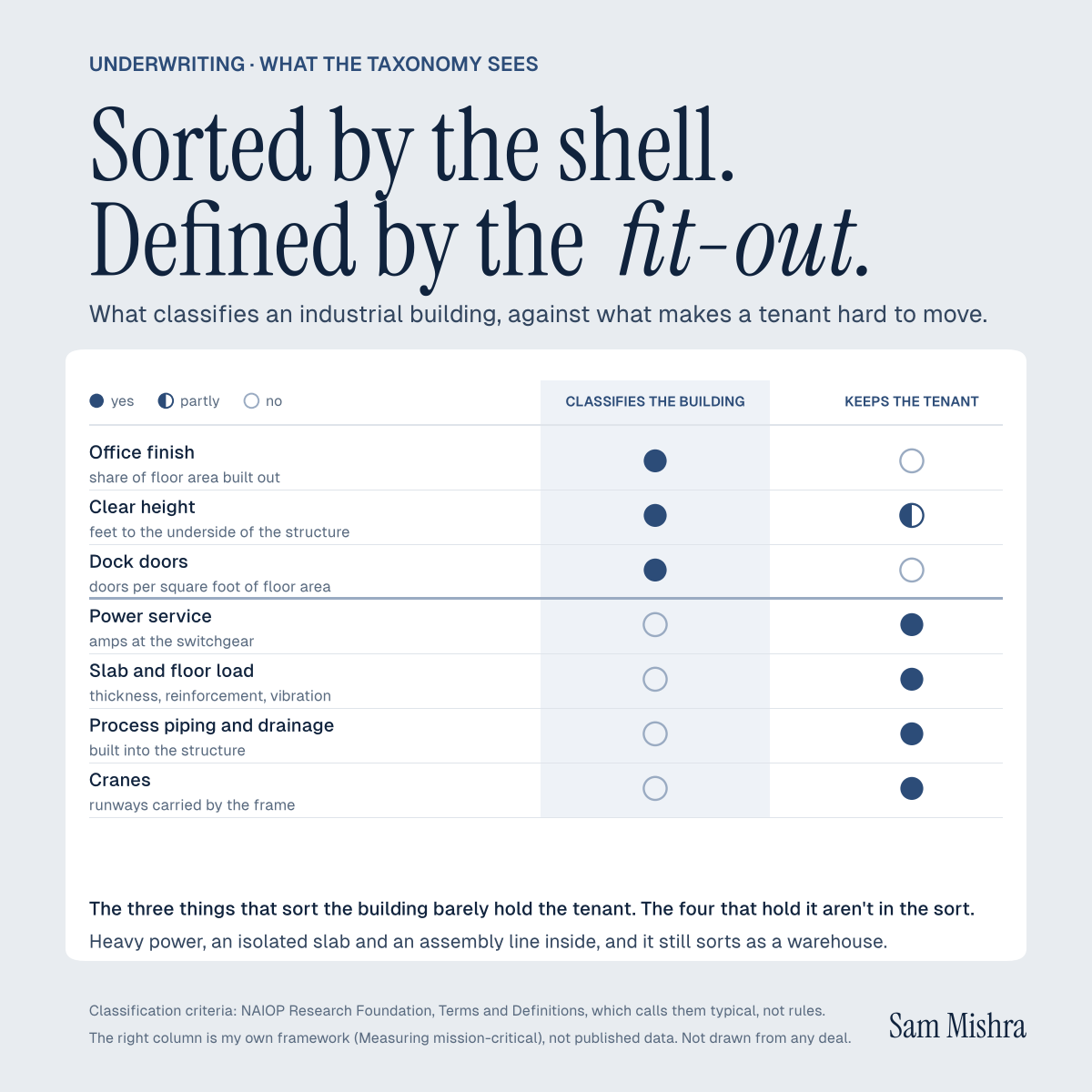
So a warehouse shell with 8,000-amp service, a thickened slab, vibration isolation and an assembly line running inside it still sorts as a warehouse. The classification is blind, by construction, to the improvements that most change what the space can do.
Avison Young measured that gap in Houston. 60% of industrial equipment and machinery tenants there run manufacturing in buildings not designated for manufacturing. Tech tenants leased warehouse buildings almost exclusively, with roughly three-quarters of operations functioning as advanced manufacturing. One metro, one quarter, so I would not extrapolate it. But it is measured rather than asserted.
So neither label is load-bearing. The tenant’s industry does not tell you what is in the building. The building’s recorded type does not either.
In October I wrote up a framework for scoring how hard a tenant is to move. Its first component is capex in place that does not travel: reinforced slabs, heavy power service, process piping, cranes, specialized drainage. That list is almost item for item what NAIOP leaves out. I did not notice that when I wrote it.
The same note argued that switching cost lifts renewal probability and loss given default at the same time. That was my read, not a published finding. ORG Portfolio Management’s work on GMP life sciences space comes close: those buildings look like typical industrial from the outside, run $400 to $600 per square foot all-in, and are “not nearly as reusable for different life science tenants.” Sticky tenant, expensive residual.
In a build-to-suit, that trade is a term. Who funds the building-integrated work and who funds the process equipment above it is negotiated deal by deal, and that one allocation decides both how hard the tenant is to move and how much of the residual stays with you.
And because the comp sheet sees only the shell, the ordinary-looking building with specialized guts is where residual assumptions go wrong, too high or too low.
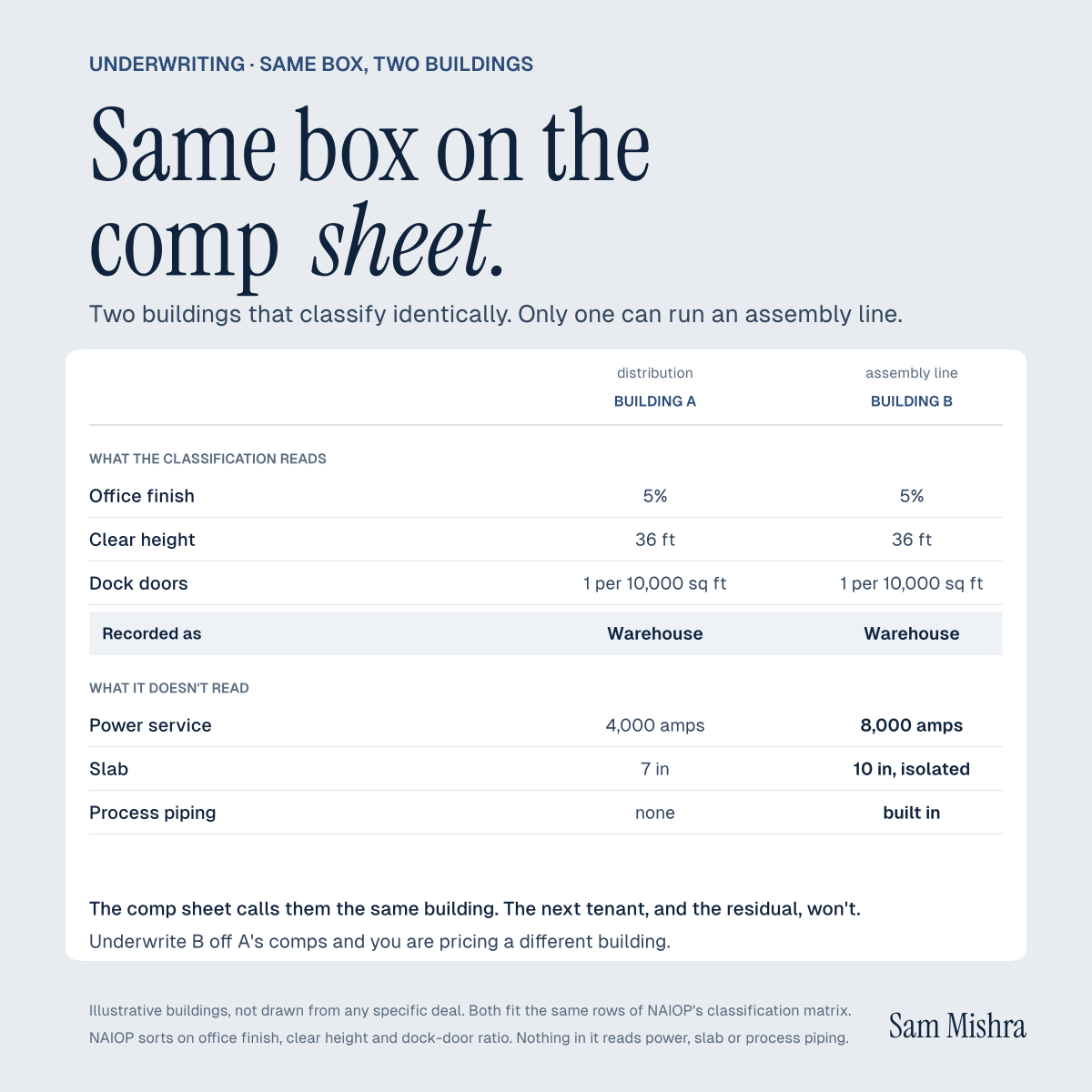
After the credit, the question is not the building type on the comp sheet. It is what got installed, who paid for it, and what it is worth to the next occupant.
The taxonomy was never going to tell you that. Read the fit-out schedule.
Follow-up · November 2026A premium has a shape →