October 2026 · Net lease & rates
A market, not a number
I’ve written that cap rates haven’t followed the 10-year — the spread against Treasuries is the thinnest in over a decade. That’s one spread. This is the other: what the asset yields against what the debt actually costs.
In 2021, a net-lease cap rate cleared the cost of senior debt by a wide margin — call it 250 basis points, the cushion leverage used to add. Today that cushion is roughly gone. Average net-lease cap rates are around 6.9% (CBRE), and senior financing now sits around or above that. On the average deal, the gap between what the asset yields and what the debt costs has compressed to about zero.
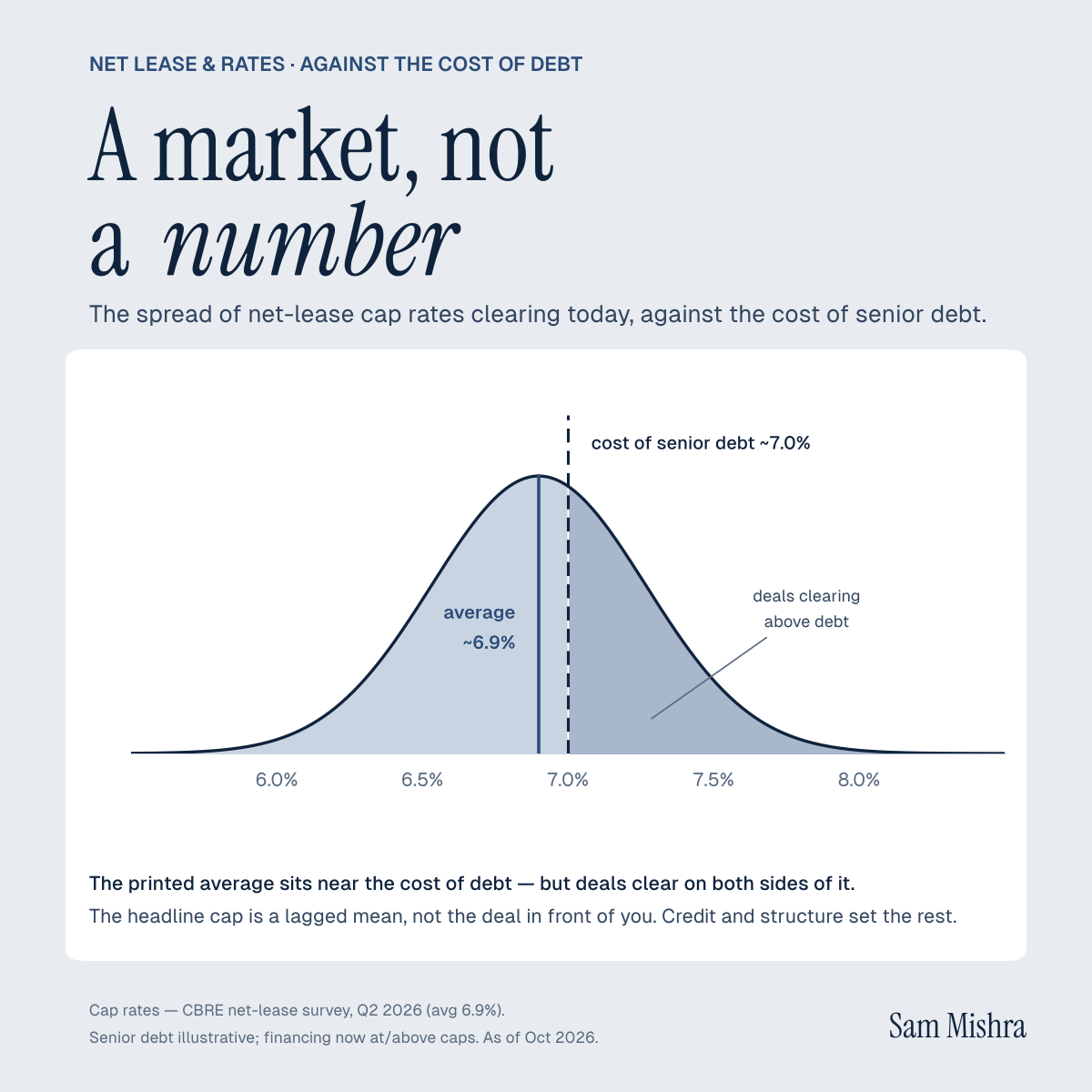
“Average” is doing a lot of work there. That’s a mean, and deals are clearing on both sides of it. Part of what separates them is asset-level — credit, basis, structure, escalators. But a bigger part is who is buying, and the sharpest version of that point came back at me from the discussion on that earlier note, from several people at once: if the buyer setting the price isn’t borrowing, why would a zero cushion move anything?
For most of them, it doesn’t. There are four pools bidding, and only one measures its return against the cost of debt.
Exchange capital — a direct 1031 buyer, or a DST — is measuring against a tax bill, on a statutory clock of 45 days to identify and 180 to close, which is much of why a DST that can close in days is attractive at all. Private capital and local buyers are measuring against the next deal in a market they know, usually with no clock at all and often across generations. Neither is solving for a spread, so a zero cushion barely reaches them: a direct exchanger is often all cash, where there was no debt to replace, and most DST offerings carry no debt at all — industrial DSTs averaged under 19% loan-to-value last year. Only the fourth pool — private and public funds — prices a spread over the cost of debt, and for them the same cushion is the whole margin. The number everyone quotes sits among four markets and describes none of them.

That bid has a ceiling, though, and the ceiling is structural rather than sentimental — and it falls in different places for different buyers. A DST cannot raise new capital once its offering closes, cannot fund discretionary capital improvements, and cannot sign or renegotiate a lease, which is why re-letting runs through a master lease to a sponsor affiliate and why the tenant credit has to carry the whole hold. What it can do is size: pooling many exchangers into one offering clears $50 million comfortably.
Multi-tenant is where that bites hardest. A DST can hold it, but only by having the master tenant absorb the leasing risk the trust is barred from taking — so the rollover sits with the sponsor affiliate rather than with the investors directly, and the investors’ protection is only as good as that affiliate, which is generally thin. A single-tenant asset on a long lease to a credit occupier carries no equivalent exposure over the hold: the tenant is bound for the term, and nobody is standing between the trust and that obligation. In my experience the multi-tenant offerings are received less well for exactly that reason, and they should be.
The master lease isn’t free, either. The trust’s counterparty is not the investment-grade occupier but a newly formed sponsor affiliate, generally thinly capitalized — thin enough that its insolvency is treated as a live risk to loan covenants — and what the trust receives is that affiliate’s master rent rather than the occupier’s, with the spread between them accruing to the sponsor. My own view is that this tells at the exit. A buyer looking at a master-leased asset is underwriting through a structure, where the same building on a direct lease to the same credit presents cleanly. That is reception rather than economics, but reception prices.
A single exchanger is the mirror image, at least on paper. Construction is formally open to them — an improvement exchange runs through an Exchange Accommodation Titleholder, which holds title until the work is substantially complete, a route a DST cannot use. In practice, in my experience, few take it. The reason an exchanger is in the market at all is deferral and a hands-off hold, and construction risk is the opposite of both. And one exchanger’s depth runs out well before the large end. Private and local capital, in my experience, thins out above roughly $50 million too; there are exceptions, but not depth.

Which leaves development almost entirely to levered capital. A DST is barred from it, a direct exchanger declines it, and private buyers rarely take it on at scale — so the segment where new supply comes from has one serious bidder, and that bidder prices off the cost of debt.
The fence runs both ways, though, and right now it runs harder against that bidder. A buyer who needs positive leverage cannot touch anything clearing below the cost of debt, which at a zero cushion is a great deal of the market. Exchange capital, DST programs and private buyers can, and are. That isn’t a market where one pool is winning; it is two books priced by whoever is able to bid on them, and the balance between them moves with the cushion rather than with sentiment.
So no pool bids on all of it. Development, rollover risk, weaker credit and size are places the unlevered pools structurally cannot go; everything clearing below the cost of debt is a place the levered pool cannot go. The 90 basis points of cap-rate movement is a blended figure across segments whose marginal buyer differs, and repricing shows up first wherever the levered buyer is the only one left bidding. How much of the hold-out that explains, I don’t know and nor does anyone else: no one publishes leverage by buyer type, and private buyers’ share of net lease acquisitions has in fact been slipping while institutional share rises. The direction I’d defend; the magnitude I wouldn’t. If the cushion reopens, that fence moves — and it moves against the pools that have had the run of the market while it was shut.
It’s also a lagged average. Real estate reprices slower than bonds because it’s illiquid — slow transaction cycles, appraisal smoothing, sticky seller expectations. When rates ran, bonds moved in minutes; real estate moves over quarters. So a near-zero cushion today is a snapshot of a repricing still in motion, not where it settles.
Which means caps still have further to travel. That isn’t a reason to sit out — it’s the reason to underwrite an exit wider than today’s going-in print, whatever your capital structure. The same illiquidity that makes real estate slow to reprice is what lets a disciplined buyer find the deal on the right side of the average.
An average describes a market. It doesn’t price a deal.
The headline cap marks the middle — the work is everything around it.