October 2026 · Net lease & rates
Rates moved. Cap rates didn’t.
The 10-year has climbed about 360 basis points since 2021. Net lease cap rates have moved about 90. The gap between them — the spread you’re actually buying — is now the thinnest in over a decade.
Net lease sits around 6.9%, a record, with the 10-year above 5%. That spread has compressed from ~450 bps in 2021, to ~240 this spring, to roughly 180 today (CBRE, Boulder).
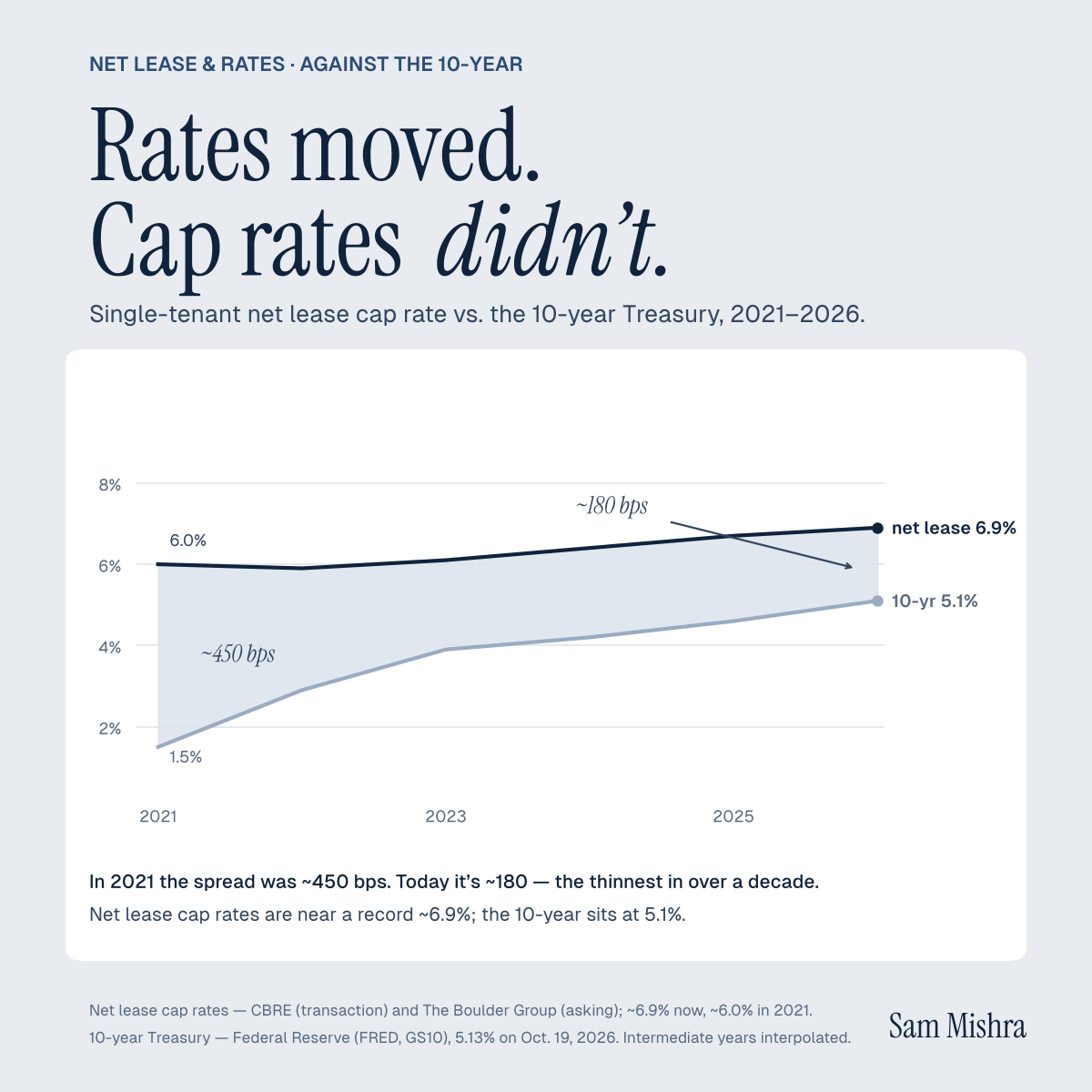
The old reflex — cap rates track the 10-year, so wait for rates to pull them wider — isn’t holding. Rates ran; capital that doesn’t need leverage kept cap rates compressed. And with permanent financing now priced above cap rates in most deals, the headline cap rate flatters the return.
So you underwrite the pieces the cap rate used to paper over:
- Credit — is the tenant money-good for the full lease term?
- Real yield — even the 3%+ escalators on new build-to-suit barely keep pace with 3.7% CPI, and most in-place leases bump far less.
- Residual — a 15-year lease on a purpose-built box is worth what the box is worth when the lease burns down.
A decade ago, a fat spread forgave mistakes on all three. At ~180 bps, it forgives none.
And as net-lease capital turns return-seeking rather than permanent, the residual stops being an afterthought — you’re pricing an exit, not clipping a coupon. Your exit clears to a levered buyer, not to the capital compressing caps today. With financing still above cap rates, a levered buyer can’t pay a tight cap — so underwrite an exit wider than today’s, however clean your basis.
The cap rate used to carry the whole story.
At ~180 over Treasuries, the return lives in the credit, the structure, and the residual.
Follow-up · October 2026A market, not a number →