October 2026 · Manufacturing credit
Unrated, not unpriced
Build-to-suit now makes up about 35% of all U.S. industrial space under construction — and more than 55% of the large-format pipeline, the boxes over 500,000 square feet. A build-to-suit plant is a purpose-built box on a long lease to the operator, owned by an investor — which is to say it’s net-lease real estate. Many of those operators are mid-market manufacturers with no published credit rating.
That’s where the reflex kicks in: no rating, no comfort, pass. But a rating is a convenience, not the credit itself. And unrated doesn’t mean sub-investment-grade — plenty of these companies would shadow-rate solidly investment-grade; they simply never issued public debt or needed an agency to say so. A 15-year lease on a plant is a stream of contractual payments from a counterparty who can pay or default — which is to say it’s a credit, whether or not an agency has rated it. You don’t need the agency to underwrite it. You need the two things the agency would have been estimating anyway: how likely the tenant is to keep paying, and what you recover if they stop.
Start with the first. The objection to an unrated manufacturer is usually that the rent sits on a single operating company with no public balance sheet behind it. But rank that rent against everything else the company pays. When cash gets tight, discretionary spend goes first, then marketing, then suppliers get stretched, then the corporate debt and the revolver get managed. The rent on the plant that actually makes the product is close to the last check a company stops writing — because stopping it means losing the ability to produce and sell at all.
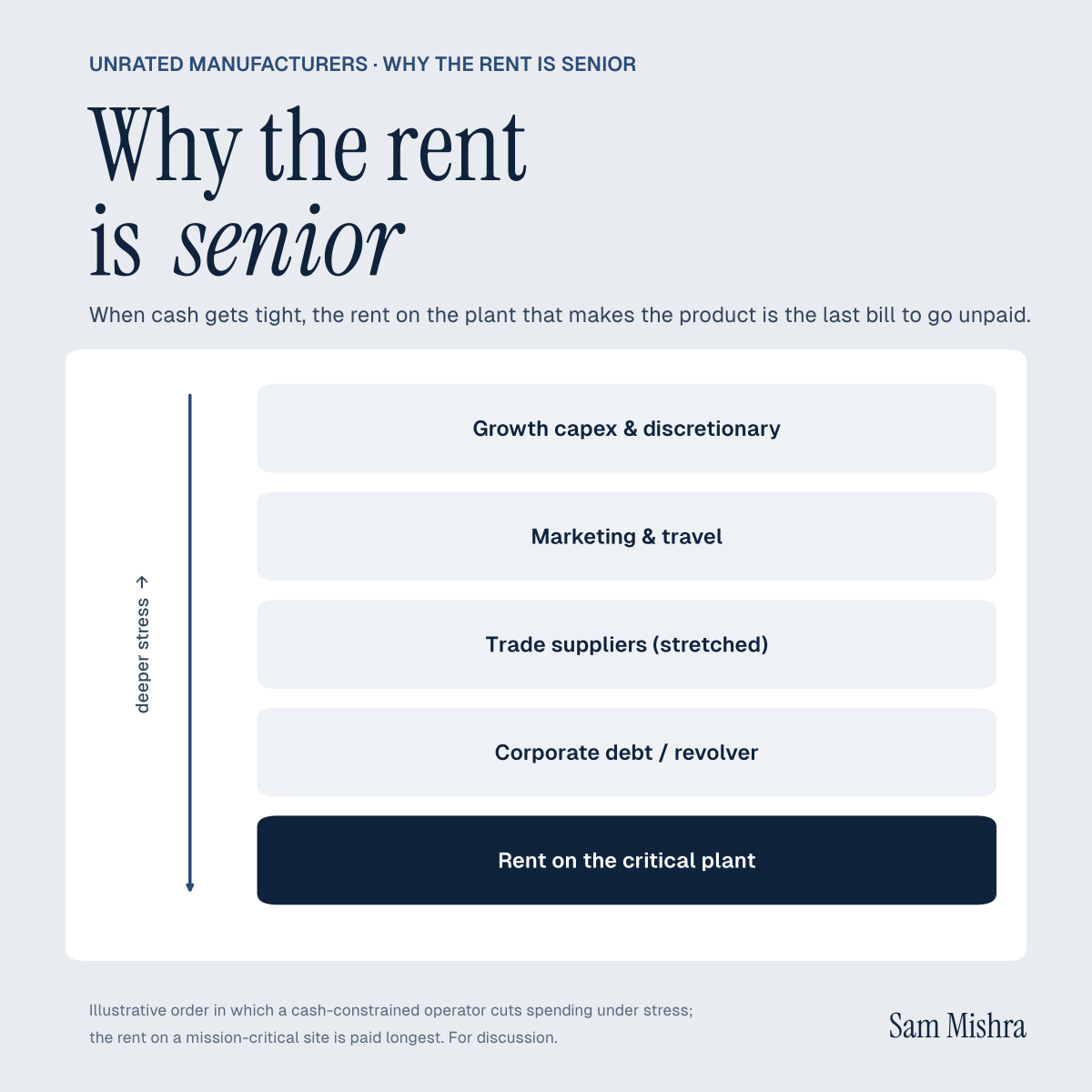
That seniority is the heart of it. The rent on a mission-critical plant doesn’t behave like a soft, back-of-the-line obligation — it behaves like senior debt the company services to stay in business. If you can establish that the plant is genuinely central to how the company makes money, you’ve established most of the case for the rent getting paid through a downturn.
Then the second question: recovery. If the tenant does default, a lease is only as good as what the box is worth to the next occupant. That’s a real-estate question, not a credit one, and it’s where the two disciplines meet. A generic distribution-style building in a deep market is fungible — easy to re-let, strong recovery, so the credit of the current tenant matters less. A highly specialized plant is the opposite: if that tenant leaves, few others can use it, so your recovery leans heavily on the tenant staying. The more mission-critical the asset, the more the residual rides on the credit; the more fungible the asset, the more the real estate stands on its own.
Put the two axes together and you get a map, not a screen. Across the bottom: where the tenant shadow-rates — an internal estimate of default risk on rating-agency methodology, sub-investment-grade to investment-grade. Up the side: how specialized the plant is — fungible to mission-critical. Every quadrant is a way to get paid, not a place to avoid.
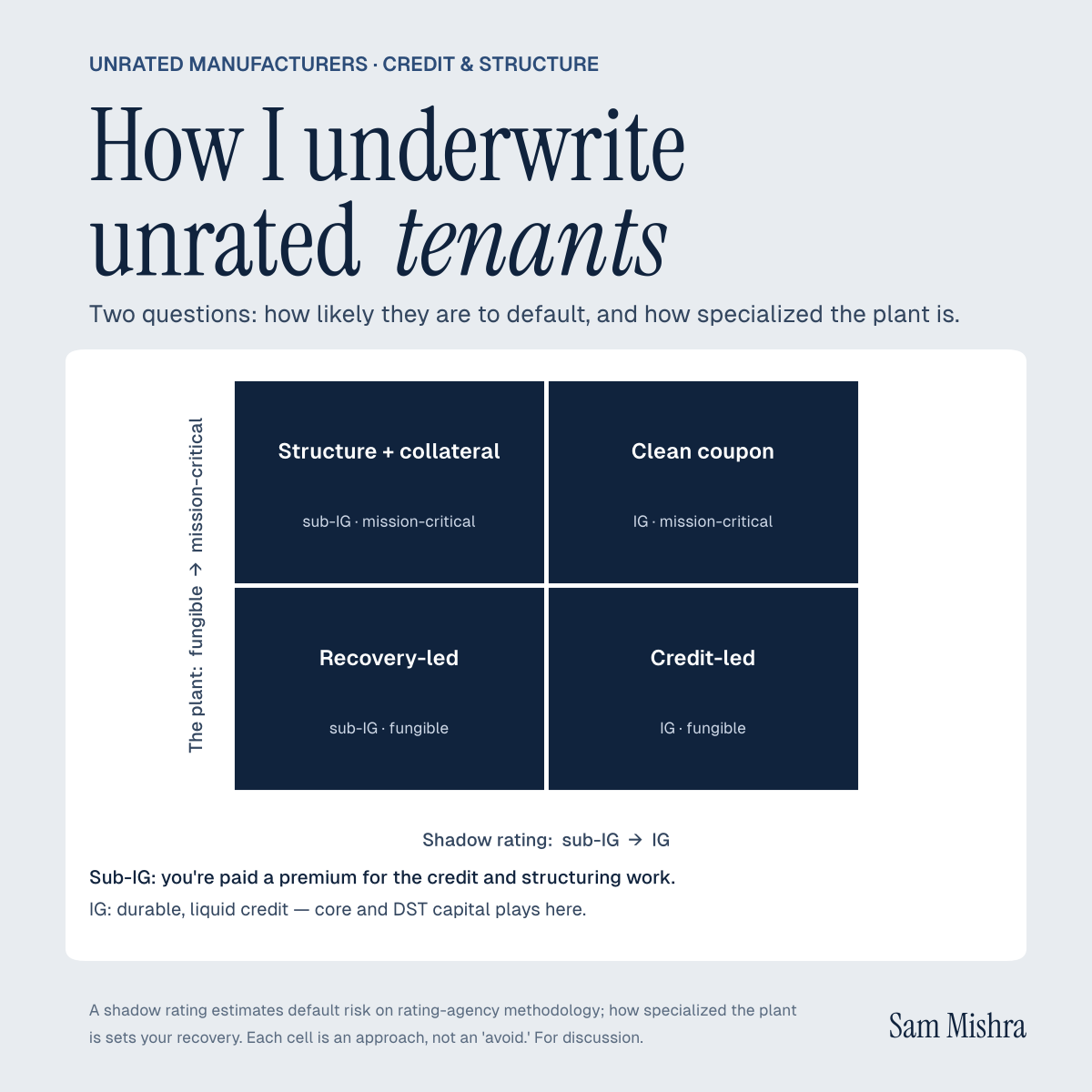
An investment-grade tenant in a mission-critical plant is a clean coupon — durable, liquid credit, and the corner where core and DST capital plays. A fungible building with a strong tenant is credit-led; the real estate is the backstop you probably never use. A specialized plant with a sub-investment-grade tenant is where structure, collateral and a defensible read on seniority earn their return — that’s the name everyone else screens out for lack of a rating. A fungible box with a thinner tenant is recovery-led — you underwrite to the next occupant, not this one.
Every one of those is a way to get paid; they just pay differently. For scale on the credit leg, corporate markets price the move down the stack at roughly 225 basis points right now — investment-grade corporates yield about 5.9% against high yield at about 8.2%. Net-lease cap rates capture a portion of that, not all of it, because the real estate carries part of the risk the bond market has to price on its own.
None of this requires pretending an unrated manufacturer is something it isn’t. It requires doing the work the rating would have stood in for.
A rating is a convenience. The credit is there either way.
It lives in the default risk, the seniority of the rent, and what the plant is worth to the next tenant.
Follow-up · October 2026Measuring mission-critical →