November 2026 · Sourcing
Off-market isn’t discovery. It’s access.
Off-market does not mean nobody else saw it. When a developer, advisor or occupier calls me, they are usually calling three or four other groups too. That is a long way from a fully marketed process, which is the point. But it is not an exclusive look.
So the real question in origination is not finding deals nobody else sees. It is how you end up on the list of five. I wrote earlier that off-market isn’t a channel, it’s a habit. This is what the habit buys.

Almost everything that earns a first call happens before there is a deal.
- Pricing a project before it exists. A developer is thinking about a site. An occupier is scoping a requirement. An advisor is weighing options for a client. There is no building, no lease, no number. What they need is someone who will tell them how it could pencil: who funds it now, who buys it at delivery, and at what return. Most never become deals. It is a numbers game, though: enough at the top of the funnel and the conversions add up to a real pipeline.
- An answer, not a number. The alternative is quoting fast off a five-minute read. Cheaper, and what a lot of capital does. It does not earn a second call, because the other side can tell a number from an answer.
- The honest pass. I also tell counterparties when I am not the right buyer. Saying so costs me nothing. I was already out. But the honest version is worth something real to them: who it would pencil with, at roughly what valuation, given the deal’s facts and which buyers have appetite right now. A fast no with a direction beats a slow maybe.
- Being useful when you are not bidding. Same with help that has nothing to do with financing. Introductions that fit their business. Ideas that solve a problem for them and do nothing for me. If you are only useful when you are bidding, you are a counterparty, not a resource, and counterparties get called fifth.
All of that is reading the capital map for them, and it pays off at site control, when the first call comes. That is when the other side most needs judgment, and when the fewest buyers can act. The deepest capital arrives at delivery.
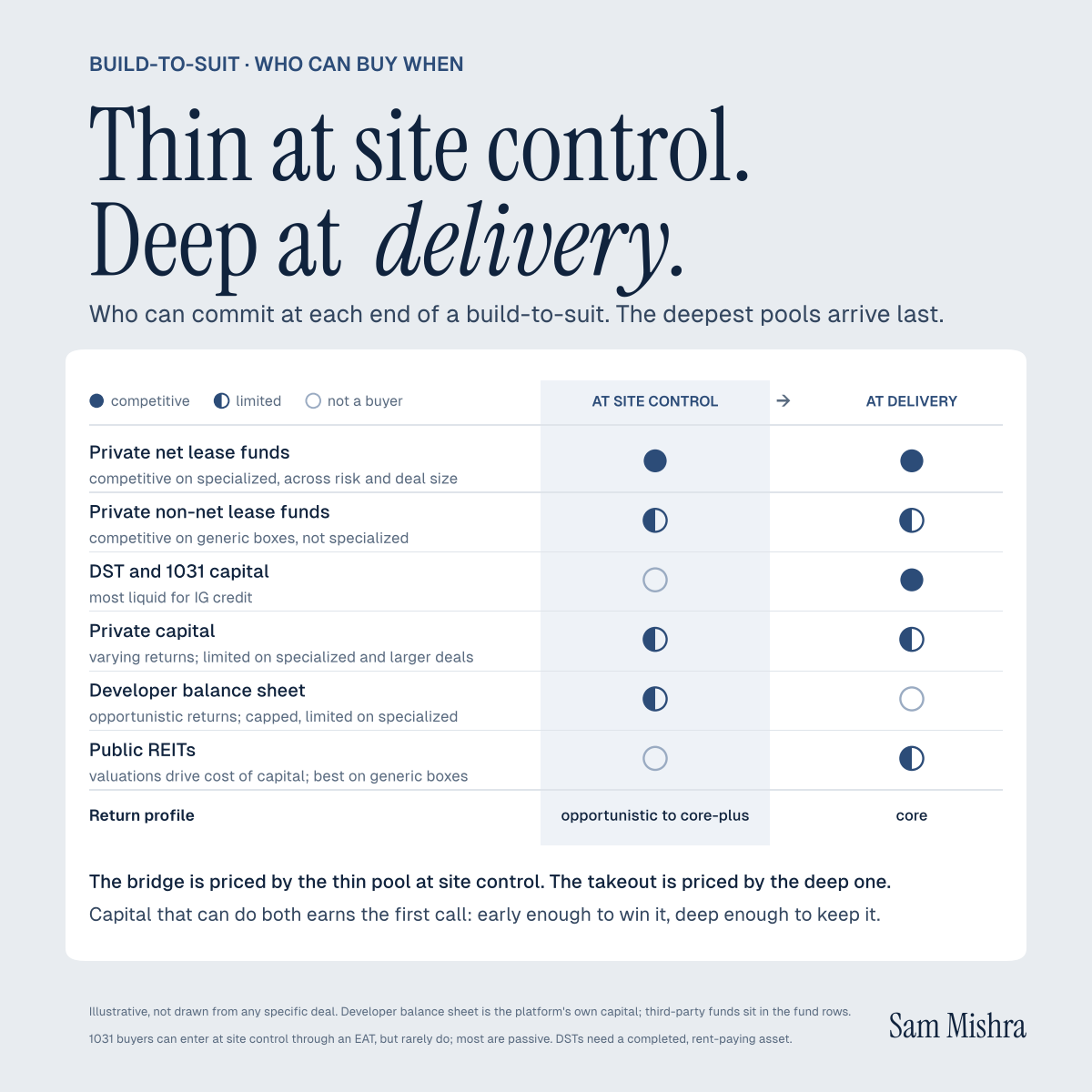
When the deal is a fit, the map turns into structure. CTL fits a narrow set of deals. The ones that matter are not regular-way: TI above market, 100% of the fit-out, or two stages: a bridge from site control, then the long-term solution once the credit is in place. The edge goes to a sponsor with more than one way in and out: a levered JV or CTL financing through construction, and a choice of takeouts at delivery, including DSTs. One partner for both stages.
Who funds the fit-out is also the allocation that decides how hard the tenant is to move later, and the bridge terms decide who carries the risk if the schedule slips. In a build-to-suit you are not inheriting those trades. You are setting them.
The hard part is none of the above. The hard part is time.
Each conversation is a claim on a finite budget, and most will not convert. So you ladder it: more time toward what is heating up, a standing allocation for the long-dated ones, follow-up on both. Cutting long-dated work because it has not paid off is how you fall off the list.
What all of this buys is not certainty. I win some of these and lose plenty. It buys a higher probability on each one and a place near the top of the call list when the next real deal comes up.
What earns the call doesn’t pay today. It builds the pipeline that does.